Sunday, February 27, 2011

Making food with what we have

I've been perusing the web for good recipes in which I can use eggs. We get at least one egg from a chicken each day, some days we get two eggs. Rarely does one hen skip two days, giving us a day off. So I've made fresh pasta with the eggs before, with delicious results. Last week I used up four eggs in some banana bread. Today I counted eleven eggs in our carton and thought some action was required. The recipes I found online are mostly custards, cakes, quiches, frittatas, and breakfast egg dishes. So I resorted to making a batch of pasta (with a twist) and turning it into ravioli. The twist was some lemon zest added to the pasta dough.

I had to decide on the filling so I looked around at what I had, and thought about what would taste nice with lemon, and came up with the idea for a filling composed of some cooked chicken (left over from roasted chicken), roasted pumpkin (I've had the pumpkin on display for months), and some garlic greens, parsley, and chard – all from the garden. I added a small pile of parmesan shavings, some more lemon zest,  and two eggs to help with adhesion, and went to work making the ravioli.

When I cut open the pumpkin, to scoop out the seeds before roasting it in the oven, I found some of the seeds had sprouted and grown roots inside the pumpkin. It was a remarkable sight, so I took some photos. I also carefully extracted a couple of the rooted plants and put them in pots. 

A tiny garden growing inside the pumpkin.
One of the sprouted seeds I planted

The rest of the scooped out interior, with a jumble of sprouted and unsprouted seeds

The experimental ravioli filling ended up being absolutely edible, but rather lemony. I was going to serve it with some reheated tomato-based sauce I had in the freezer (left over from a batch of lasagna I'd made a while back). When we tasted the sample ravioli I cooked, it seemed like it would be better with an alfredo sauce. Well I nixed that idea on account of my cholesterol and my waistline, plus it would have meant a trip to the store. So we had it with the tomato sauce.  

I froze two trays of ravioli though, so maybe we'll try the alfredo sauce when we cook the next batch. I'll have to invite company though, so I can justify buying the heavy cream.

Friday, February 18, 2011

Almond Blooming Season

The almond trees are exploding with blossoms. The weather has been cold and wet and I wonder if the bees are even out pollinating. The almond crop might be compromised this year.
The almond trees are the first to flower, and they really brighten up the back yard when they bloom.
Almond blossoms

Just an egg

Chicken #2 laid an egg.
Egg

Saturday, January 29, 2011

Chicken food

Chickens eating walnuts.

These chickens have well adapted to their new, larger range. I've made a very large yard for them to use for foraging and whatnot. I bought a few rolls of black plastic fencing, which is very light weight and easy to maneuver. Their area now includes a space underneath  some small trees that had collected lots of leaf litter for them to dig into. They can also dig around under some shrubs and young olive trees. Since these chickens are not particularly large, they don't seem to do too much damage to the trees. In fact, they are keeping the grass down around the trees, and foiling any pest build up. On occasion I'll let them out of that area and they inevitably head over toward the house and the granite patio. I'll let them hang out around the house for awhile and then lure them back to their own fenced area by cracking walnuts with brick. They know what the sound of walnut shells breaking sounds like, and they make haste to get to the spot where I crack the nuts. They love to eat walnuts, and do so with a real fervor.
Walnuts have lots of that healthy, omega 3 fat in them, so I'm thinking that will make the eggs omega eggs.

The eggs are coming two days on and one day off, from chicken number 1 at this point. Chicken number 2 looks like she's getting ready to start laying (her bottom is starting to get larger).

I am enjoying the chickens much more, now that we have grown more accustomed to each other, and I love that the hen eats bugs and walnuts and other things I don't like to eat, and then makes eggs out of them. The rooster has grown into a beautiful, bird, glossy black feathers shine green in the light. His ruff and tail feathers are fantastic.

I can see how important it is to have animals in a Permaculture situation, they offer so much as labor and as food. They keep weeds down, create food with their eggs, and break pest cycles. They also make fertilizer for the garden. The coop litter (straw and wood shavings) will mix with all their crap and become a wonderful addition to a compost pile.

Tuesday, January 25, 2011

Hummingbird nest being refurbished

A hummingbird hen has been working on updating the furnishings of last year's hummingbird nest. The nest was in such a protected spot that it suffered little wear and tear during the winter winds and rains (thus far). A hummingbird has been sprucing up the place, adding pieces of spider silk, and other materials, to the exterior and interior. Soon, I suspect she'll be sitting on eggs, though it isn't even February. I did witness various hummingbird mating activities in the past month or so. The male soaring way up high and other macho acts.

Last year's hummingbird event was so incredible! It is looking as if it will happen again. We have had a pretty mild winter, but we're barely half-way through it, so I'm wondering if she'll lay eggs soon. It will be clear though when she starts sitting on the nest. I'll try to get more photos of the process, but will be mostly content to watch it and not bother the birds.

Saturday, January 22, 2011

A Sunny January Day

Today the weather report said sun and temps of 75 F.
It was a lovely day to spend in the garden. I let the chickens have the run of the whole yard. They like to hang out on the decomposed granite patio and also to dig in the Mulberry leaves, which cover the mostly ornamental beds nearby. The hen that is laying is very focused on finding bugs to eat. She scratches at the leaves and then snaps up any bugs she sees. The rooster and the other hen do the same, but with less focus.
While they were visiting various places in the yard I spent some time collecting scion wood from the white peach and the Moorpark apricot. I'm going to work on grafting in the spring and want to have some dormant wood to work with. I'll try grafting them both on various peach seedlings I have growing in a few places. I also took some black currant cuttings and stuck them in the ground.
Around 2 p.m. the hen which lays went into the coop and settled into her little dent in the straw, and went about laying an egg. I watched her from the window for a while and she seemed to not be making progress. Then the rooster and the other hen came in, and he stood right by her and the other hen took a little nap nearby. All this went on for some time, so I left and waited, until I saw them come out of the coop, to go get the egg. It was still warm when I picked it up. I now have half a dozen peewee eggs in the fridge. This is a collection from the past week or so.
The peewee eggs translate to large eggs with four peewees being the same as 3 three large. Last weekend I used four peewee eggs to make a batch of fresh pasta that I then used to make ravioli. The yolks were such a deep yellow that the sheets of pasta were a brilliant yellow when the sun shone through them.
Chances are good I'll repeat the procedure. The raviolis were delicious. Fresh made pasta is a wonderful food.

Saturday, January 8, 2011

Hydrologic cycle & three more eggs

Sunset Jan 2011.
We visited the Pacific Ocean for five, mostly-sunny days. Every day we walked on the beach, a little further each day. On our last full day there we walked seven miles on the beach, in bare feet. The water was cold and the sand was cold, but there was enough sun to keep us warm, so long as we kept moving. Many days of rain preceded our visit, and some areas to the north and the south of where we stayed were experiencing landslides and broken sewage pipes leaking into the ocean. I wanted to visit Moonstone Beach State Park near Cambria, but that beach was considered too toxic from a sewage leak and other toxins in the water system, and was closed. Knowing that our water will make its way to a creek, river, lake, or ocean, should  keep us keenly aware of what we put into it as "waste." In April of 2010 Time magazine did a piece about various pharmaceuticals making their way into water supplies. The hydrologic cycle is a local and global concern. It sure is beautiful to look at too.

Three eggs, in the carton now, with the pointy end down.
When we returned I found three more eggs deposited in the chicken coop. They were on the floor in a corner, not in the nest boxes, so I've put two fake eggs into a nest box to help encourage the chickens to lay in there. I'm not sure if the chickens will get it, since the eggs are purple and green. They are musical shaker eggs but they were the only "fake" egg-shaped thing we had around just now.

After consulting a chicken book I weighed the eggs and found that they weigh 1 1/4 - 1 1/2 ounces each. The formula for figuring out their weight is to multiply the weight of one egg by twelve to get the carton weight. These eggs rate as "peewee" sized eggs. The book also says the eggs should get a bit larger in the coming weeks, so I'll weigh future eggs to check on that assumption. Every chicken book I consulted said that chickens would not lay with less than 14 hours of daylight (which is one reason why many people put lights in their chicken coops). I have no artificial light in the coop, so I'm still not sure what the scoop is with that idea. We are only getting about 9 hours 45 minutes.

Sunday, January 2, 2011

First Egg

Well, there it is. 
What a surprise to find a little white egg in the chicken coop, this second day of January.
The books I've read said the chickens wouldn't lay with less than 14 hours of sunlight, so I didn't expect any eggs until spring.
I admit it was exciting to find the egg.


First egg interior. A very deep yellow yolk, which is held high in the white.


The first egg yolk (top) is much deeper yellow and the white is much firmer than the commercial egg (bottom). These two eggs were put into a batter for banana bread.  

Thursday, December 16, 2010

Chickens are growing

Chicken number two

Rooster

The three chickens are getting used to things around here. They arrived one hot day in the summer. Now that we've had rain, frost, and a few good north winds with downpours, they're no longer running into their coop with the slightest bit of rain or wind. They generally spend most of the day outside, foraging for plants, bugs, worms, and seeds. They do get particularly excited about worms, so if I find one that is waterlogged on the pavement, I'll take it back to the birds where they pick it up and carry it around, keeping it from one another.

Last week they had a visit from a small hawk. I heard the hens making an uproar and looked out to see them in a flap with a small hawk. The hens fought the small bird off, sending it to a nearby branch, and when I went out to check on the birds the hawk flew off. Assessing the scene I noted the rooster napping nearby while the hens were in rather a froth about the fight. I felt a tinge of pride in those two hens. They all went into the coop for a while, and then came out again a bit later.

The rooster is working on getting his crow just right. He's not singing his song regularly, but more frequently now. Some days his tone is a little better than others. I think with practice he'll have a nice bel canto crow with which to express himself. His black feathers have a lovely greenish sheen in the light and he's learning to share!

The hens have established their peck order and it was heavily enforced for weeks, and now they've seemed to relax about it a bit.

One unexpected delight for me is the sound they make when they drink water. They dip their beaks into the container of water, then tilt back their heads and make a gentle tapping sound while they swallow the water. It is such a simple act, taking a drink of water, but I love watching and listening to them while they do it.

One recent weekend day I let them have free run of the entire back yard. Anywhere they wanted to go I'd let them. I was working out in the garden most of the day and they made their way to points previously not visited. They roamed around—a little cluster of black and white—and explored their larger world. They generally have about 100 ft of fence to explore, but that day they roamed near the apple trees, across the small lawn, and a bit into the main food garden. When they got back to their familiar rosemary bush in the afternoon, I started closing up the fencing so they'd be sure to find their way back into their coop when the time came.

I find it very beneficial to have the birds as part of the garden. I do not feel sentimental about them as pets (though I'm warned that may come) but I do like having them as workers in the garden. Like our cat makes our house feel warmer and comfortable to us, the chickens make the garden feel more alive to me. They are fertilizing and eating bugs, and creating movement out there. I can usually see them from my desk, and when I feel like taking a break, I'll head out to watch them for a while.

Saturday, November 27, 2010

Pumpkin pie experiment

This week I cut apart one of the Winter Luxury pie pumpkins and roasted it in the oven, then made a pie out of the pulp. The flavor and texture were both delicate and wonderful. And the pumpkin produced many seeds, which I saved for growing more of these delicious pumpkins next year. In the past I have made my pumpkin pies out of butternut squash flesh and they have been delicious, but this winter luxury pie pumpkin has a much more subtle and refined flavor. I cut down on the amount of spices which the recipe called for, to allow the pumpkin flavor to be available to the palate. This pumpkin definitely lives up the the description I read in the Nichols Garden catalog which states:


Beautiful 5 lb, 10" diameter, netted pumpkin is what every pie pumpkin promises but rarely delivers. Completely smooth, thick flesh cooks to a rich mellow flavor. A friend asked a market vendor to recommend a pie pumpkin; she reached under the counter and exclaimed, "This will be the bes you've ever had," as she brought out a Winter Luxury Pie.


The pumpkin I used was the largest of the harvest and produced six cups of cooked flesh, enough to make three pies total. I froze the remaining flesh in two-cup increments. I'll be ready to make another pie soon.

Monday, November 22, 2010

Cold Weather

Lemons
We've got a frost alert for the next few nights. This means various tender plants need to be protected from the cold, mostly citrus. This evening I went about covering and insulating my two lime plants and two lemon plants. I also picked most of the lemons from the lemon tree that bears fruit. Last year the fruit froze and fell off in a cold snap. This year I was looking forward to harvesting lemons on an as-needed basis. Now I have a basket full of lemons that will need some sort of processing. I could juice them and freeze the juice or I could make lemon marmalade. I love the idea of doing some of each.

I started making some green tomato jam yesterday, and it is resting before I'll cook it up some more and then process it in half-pint jars. Since water bath canning is so energy intensive I could do a batch of marmalade and process them all on the same day.

Thanksgiving day in the USA is on Thursday, November 25 this year, and I'm thinking I'll make a pumpkin pie using one of the pie pumpkins I grew this year. I'm going to brine two organic chickens on Wednesday and then on Thursday I'll roast them in the oven. One will be stuffed with tomato and feta from my Greek cookbook, and the other will be unstuffed.  We'll have mashed potatoes with lots of butter, perhaps some pan gravy, collards from the garden (which will be nice and mellow from the frost) and perhaps a few other things. I enjoy cooking with things that I've grown. The pie pumpkin and collards in this case. A few weeks ago I made some pumpkin cannelloni with one of the French heirloom pumpkins I roasted and some tomato sauce I made in September, and had in the freezer.

Sunday, October 31, 2010

Fall rains

Cool fall rains have finally arrived and have washed the dust of summer away. The air feels clean and the plants are refreshed.
Walnut harvesting has begun in the orchard across the street. Normally that would mean a dust cloud for days on end but the rain has helped keep that down.
Our walnut trees are dropping nuts and I've been harvesting them. The chickens seem to like walnuts so I've been feeding the broken nuts to them. The best nuts from our trees will be given to friends. It is rather a shame that walnuts do not appeal to my palate since we have so many nuts from the big old trees.

Along with the cooler weather, and the rain, the abutilons have really started to look their best. They struggle a little through hot weather and then they thrive once it cools some.

Abutilon
This yellow abutilon is visited frequently by hummingbirds and is a plant I grew from seed.

Sunday, October 10, 2010

Fall Gardening

The temperatures were in the 80s this weekend, a little warm for the chickens so I put the mister on to cool down their yard, but not too hot for me to move a pile of old ivy and sticks. This pile was created  out of branches and pieces of cut ivy. I piled and piled and finally I decided the pile wasn't doing much but making a comfortable home for a few mice. We get such little rain here that it would take so very long for that pile to break down. I had tried planting squash to grow upon it, but the rodents chewed through the squash plants, killing them.


Old ivy on top of new...
I've been saving up cardboard boxes and flattening them for use as ivy suppressors. There is still so much ivy, even though a huge pile has been pulled out. I've put down cardboard in a large area, spreading out a little at a time. I finally had a critical mass of cardboard and laid it down on top of the ivy, then I took the pieces of the pile—sticks and dried out ivy mostly—and spread that on top of the cardboard. Geoff Lawton of the Permaculture Research Institute of Australia says that a forest grows on a fallen forest and so my food forest will have plenty of organic matter to build upon and grow into.

With the pile gone, there is a rather large space, maybe 30ft by 30ft (I've yet to measure it), that is ready for a garden. I am thinking about making a small lawn in the middle, upon which to lounge, and then make the edges into a chicken-friendly pasture. At the back end of the space is a very old almond tree and some old lilacs, at the base of which I am thinking of planting lavender, keeping it pretty drought-friendly. Beyond those trees is the chicken house and yards, with a small foot path connecting the spaces.

At one edge is a group of trees that has been acquired as scaffolding for a large grape vine. The wild birds love to come and eat the grapes when they ripen, creating a cacophony of bird song and various bird arguments. At the parallel edge is an island of ivy with a mature cypress tree and some old fence posts covered in ivy that haven't been taken down yet. Still lots of ivy remains. And at the other end, is the entrance from the decomposed granite patio, where much outdoor time is spent, and also a male American Persimmon which had been coppiced many years ago and how has several long trunks. The grape has made its way from another almond, which resides next to the fruitless Persimmon, into the Persimmon. Once the pasture is installed, it should feel like a nice meadow in a ring of various trees. It will require summer irrigation and I am looking at tall fescue for the more refined lawn area, as it has lower water requirements than many grasses. Plants suitable for chicken forage will go in the rougher area.

I was somewhat surprised at my desire for a small lawn in the backyard. I've been spending time and energy removing the lawn in the front yard and replacing it with various useful plants. We've lounged around on the remaining front lawn in the summer, and it is rather pleasant, save for all the dog walkers and other people who can tend to take a look at whatever we're doing. Our street also gets some maniac drivers who roar down the 25 mph street at 45 mph, or even faster. That makes our little cat nervous, and us nervous about our cat. The shrubs will grow up taller in a few years, but I am not interested in having an audience when I'm hanging out in my gardening clothes and having a refreshing beverage. So I feel that a small lawn/pasture area will make a nice lounging setting that is more private, and have a more pleasant feel for the people and the cat. It will also provide a nice forage area for the chickens.
. . . 

Nicotiana tabacum 'Havana'
This year I grew some tobacco plants, just to see what the plants looked like. Tobacco has a long history with humankind and I am interested in plants that people have found or do find useful. The plants made very large, sticky leaves, which smelled of tobacco, and they bloomed with these long pink flowers at the tops of 3-4 ft plants (in partial shade). They are the prettiest plants in the garden bed they're in, and they brighten up our fall evenings.

Thursday, October 7, 2010

Berm & Basin and other things in early Fall

The weather is starting to feel more autumnal, leaves are dropping, the air is cooler, wind has kicked up, we have even had some rain. The walnut trees are dropping leaves in the front yard, and the berm/basin area is a great collector of the leaves. The leaves gather at the edge of the road and the planting area, and they also fall in from above. I'll rake them off the grass and put them in there too, or use them in mulch piles around the pomegranate and peach in the front yard. The bamboo is sending up several new culms, so we'll have a good clump soon enough.
Berm and Basin progress.

The sole surviving pie pumpkin plant made two nice pumpkins, which have been curing in the sun. The other pumpkin I planted is a Cinderella's carriage type, which has more pronounced ribs and is flatter than these winter luxury pie pumpkins. The Cinderella pumpkin is a French heirloom type and is apparently good for pie also. More of the Cinderella plants survived the gopher attacks and so I have many of those pumpkins to try this year.

Pie pumpkins curing in the sun.
The chickens are adjusting to their environment. The male bolts through the chicken door when I open it in the morning, and the females follow a little timidly. I've made a temporary fenced area that connects to their more secure fenced area and I open their gate to let them out into a larger and grassier area. They scratch and eat grass, which seems to be their favorite food, and then when the early evening comes they all go back into their house. The male has consistently been roosting now and the females still want to be in the nest boxes, so I move them onto the roosts when it gets dark. One night this week they all three went on the roosts of their own accord, so perhaps they are starting to get the idea. It is hard to know what goes on in the tiny bird brains.
Male chicken.

Wednesday, September 29, 2010

Hot weather in early fall

We've been having a bit of a heat wave here, with temperatures in the high 90s and even cresting 100. My chicken books say that hot temperatures can be deadly for  chickens, so I've hooked up a fine mist sprinkler to spray over one part of their outdoor pen to cool the air down. I've been refreshing their water several times a day to keep it cool, and they seem to be doing fine. The male will even stand under the mist, while the females tend to avoid it.

In early September we had cooler weather and so I started thinking about taking fall cuttings of some plants I want to propagate. I took some lavender cuttings back then and put them in a shaded spot, close to my office door so that I would be sure to pay them the care they need – frequent watering mostly. Now I am not sure if they are going to make it with all this heat, but it'll be a good experiment. And if any of them do make it, all the better.

The berm in the front yard is looking pretty good, considering I don't water it much and that most of the plants are from re-seeding. There is a lush growth of new calendula, daikon, and fava beans. The pineapple guavas look pretty good and one of them even has a few fruits. In place of the ginkgo tree that the gopher killed I've planted a lime tree. The poor thing had a crowded root system so I pruned the roots and the top very heavily before planting it, I mulched it very well, and now it is sending out new growth, while in amongst the flush of calendula, etc. A few strawberry plants I moved out there in the spring have taken hold and are sending out runners. Strawberries make such a nice groundcover, and the fruits are pretty good too. The sunflowers have finished their show and are now ghosts towering over the other plants, as are the hollyhocks, their long stalks covered in seed pods and the odd flower.

The bamboo served as a great support for the pole beans, and it has started to push up some new growth.
Alphonse Karr bamboo with pole beans.
Detail of beans on bamboo.

Thursday, September 16, 2010

Chickens

After attending my first Permaculture workshop at a farm in New Mexico, I decided that I wanted to get chickens. The farm had many chickens and turkeys which they moved around the place to help with weed control and insect control. I was interested in the weed and insect control, as well as feeding garden excesses to the birds and getting something I could eat in return, mainly eggs.
And so I returned home all excited about getting chickens and my partner went to work building a 6x8 chicken house with nest boxes and a human-sized door and a chicken sized door. I painted it before the winter rains came and then I stalled on building the fence. I am not particularly handy with certain types of projects. Like building a fenced in yard for chickens. The winter rains came and we got some leakage in the house, but nothing too bad, it just needed a little modification.

White-crested black Polish bantam chickens. Two hens and a rooster.
In my master gardner training and such, I met a man who had raised chickens from his own chickens, and he said he'd give me some of the new flock. And he showed me picture of the tiny chicks with their little white heads on top of their little black bodies. 

Off to the hardware store I went and loaded up my little car with fence posts and poultry netting and other fencing. And I went to work creating a fenced yard for the chickens and my partner went to work modifying the chicken house to keep the rain out of the few leaky areas. 

The chickens arrived yesterday afternoon, a little hot and a little shaken up from the drive from the farm. 
Today they were up and preening and drinking water. The rooster was patrolling for bugs and they all seem to be adjusting to their new surroundings. In a few days they'll get to go outside in the daytime, where they'll be able to scratch and dust and so forth.

Next spring they'll probably be laying eggs and hopefully they'll be helping with weed control and insect control.

Saturday, September 4, 2010

Catching up...

Luxury winter pie pumpkin
September fourth and I haven't made an blog entry for approximately one month. Things are happening out there in the garden. My luxury winter pie pumpkin vine (the sole survivor of the gopher/microtus infestation) has two lovely fruits maturing on the vine. These pumpkins are supposedly delicious for pie – I've been using butternut squash in my pumpkin pies for a few years now, and they've been delicious. If these luxury pie pumpkins are sooooo much better, I'll definitely plant a ton more next year and hope for a bushel yield (unless the rodent population has abated by then–I'm working on it).


What else? Well the popcorn is starting to mature. Various winter squashes are putting on weight with time to mature before the cold weather. I've planted a few decorative things in the immediate patio area. Native dicentra, and a few other things. I've moved some of the crispy heuchera from the front yard (solar oven microclimate) to the part shade in the back. I continue to move the alpine strawberries from the way-back to the near-back. Those seem to like the heavier shade and a bit more water than the dry, baked area I am too scared to water for fear of gophers destroying my figs trees. Some successful trapping has occurred. Four gophers in two days, actually. And then a mole (they share the tunnels and I feel bad when I get one). My gopher to mole ratio is pretty high though, so, it is what is called collateral damage. 


The tomatoes which survived the ruthless attack from the gophers are almost exclusively cherry tomatoes. Black Aztec from Suzanne Ashworth via seed savers exchange. These are a very delicious tomato. Sweet and tart and copious in quantity. Also from Suzanne I've had excellent yields on the tomatillo plants I grew from her seeds.


Members of the cucurbit family have not fared entirely well. More than a few cucumber, melon, and squash plants were eaten by rodents. The rodents ate many of my bean plants too. They ate all kinds of things this year and left me feeling rather hopeless at times. A few of the bean plants that did make it through are starting to make pods! Including one that grew with the bamboo I planted in the front yard. The bean has spiraled up the stalks and is hanging seed pods in the air. My corn variety this year was popcorn and has not fared well with the invasion of gophers. I'll have a few kernels to try popping, but my crop was so impacted that I'll not have enough genetic variety to save the seed.


The front yard has sprung to life in the berm/basin area, after a spell of certain unattractiveness. Orange Cinderella pumpkins are growing out front. Various other plants went to seed and are re-growing from new seed - daikon, hollyhock, calendula. It looks sort of lush just now. I've been watering out there some.


The Thompson seedless grape in the front yard produced a few berry clusters this year. They were very sweet and delicious. The lemon tree has quite a few fruits on it, and is also draped in orange Passiflora caerulea fruits. 


I've planted some things for the fall garden. Peas, lettuce, arugula, collards, chard. I'll plant some spinach seeds I was sent when I renewed my Seed Savers Exchange membership. I hope they perform better than the German Pink tomato seeds they sent. It is a potato leaf variety of tomato and it produced not one fruit while it grew beside the prolific cappuccino cherry tomatoes from Suzanne Ashworth, across the way from the Black Aztecs, and near some Amish pastes - all of which produced fruit. Perhaps it is just the potato leaf varieties that don't work for me. Last year I planted one in a spot that I felt got enough sun but the plant did not produce. This year I planted a non-potato leaf type of tomato plant in a spot very close by and it fruited.


Back to planning the fall garden......

Thursday, August 5, 2010

Feathers

Sitting out under the empty hummingbird nest I found a tiny feather. I can't be certain that it belonged to a hummingbird. A photo here of the feather in question, a cherry pit for scale, and a scrub jay feather that was also in the back yard.

Tuesday, July 27, 2010

Ginkgo

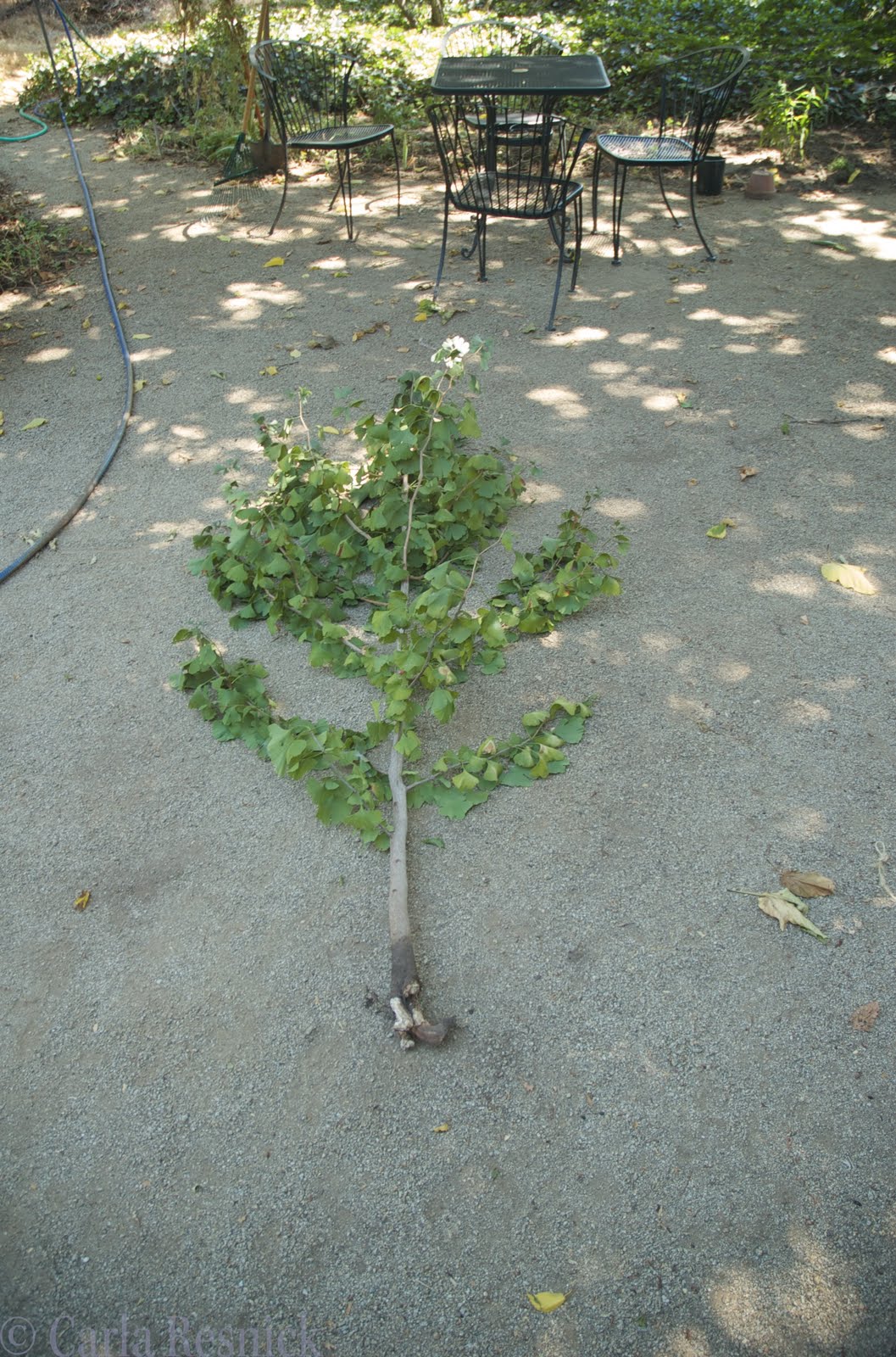
Last week the weather was rather hot and the ginkgo in the berm was looking a little droopy. I don't water there much and the tree had been in that spot for three years - it was one of the first things I planted when we moved into this house. I cut up a little circle of lawn and put in the ginkgo seedling I grew from seed I harvested from a tree in our previous neighborhood. The tree thrived and grew to a height of 8 ft over the few years.
I gave the tree a nice, deep watering and went on with my life. Last night I looked out the kitchen window to see the ginkgo tilting at an angle. When I pulled it out there were no roots and just a chewed lower trunk left.
gopher damage to ginkgo
I wondered why the gophers left the tree for three years and I also wondered why hollyhocks still stood in the berm, when in years past those hollyhocks would have been long gone.
I am now accustomed to the loss of plants to gophers, and I do feel sad about the loss of this tree. It is somehow different to grow a nice tree than to buy a nice tree. I felt a certain pride in the tree. I was also excited at growing a seedling ginkgo, which creates diversity in the gene pool, unlike grafted male trees.
Ginkgo
The tree will not go to waste, the leafy branches will become mulch for the persimmon tree in the back yard and the trunk will perhaps become a bean pole or a stake for something or other. Perhaps I could fashion it into a spear with the special power to pierce the earth and get a gopher every time.

Friday, July 23, 2010

Gardening for the birds

With the gopher invasion taking down tomatoes everywhere I look, microtus helping themselves to the squash plants, right at the start of their stems, thus rendering the remainder of the plant dead, and the destruction of other various plants by other various rodents, I find myself appreciating the birds who come to the garden. This little yellow bird sat atop this blooming/seeding catnip plant and picked away at the small, black, seeds inside the seed pods, while I stood not more than 8 feet away. While I stood still, with my camera pointing in his direction, I heard a delicate rustling under the plants to my right, and when I looked that way I saw a small, furry creature and the opening to its burrow. I remained calm, so as not to interrupt the feasting bird, and made a note of where that little rodent has made its home. A spade will be dispatched to that area later. A small fig tree I grew from a cutting has had its roots eaten away, and I fear for my larger fig trees. I feel a certain vigor returning in my setting of gopher traps.